1. Why Can Dimensions Matter for Sourcing
Aluminum cans are thin-walled pressure vessels. The body diameter, neck finish and height must match your filler, seamer and pallet layout. A brewery moving from Standard 355ml to Sleek 330ml, for example, usually needs new starwheels, seamer chucks and conveyor guides.
Dimension also ties to liner integrity. The internal coating has to cover the drawn and ironed wall evenly so acids in the beverage do not reach the 3104-alloy metal. That is why food-contact compliance depends on both geometry and coating.
2. Aluminum Can Dimensions Master Chart
Use this chart to compare capacity, diameter, height, end type and pressure rating across the main profiles we supply.
| Can Profile | Nominal Capacity | Body Diameter | Total Height | End / Lid Spec | Max Internal Pressure | Layer Qty (Est.) |
|---|---|---|---|---|---|---|
| Standard | 330 ml | 66.0 mm | 115.19 mm | 202 B64 / CDL | ≥ 90 PSI (6.2 bar) | 389 |
| Standard | 355 ml (12 oz) | 66.0 mm | 122.22 mm | 202 B64 / CDL | ≥ 90 PSI (6.2 bar) | 389 |
| Standard | 450 ml | 66.0 mm | 153.08 mm | 202 B64 / CDL | ≥ 90 PSI (6.2 bar) | 389 |
| Standard | 473 ml (16 oz) | 66.0 mm | 157.23 mm | 202 B64 / CDL | ≥ 90 PSI (6.2 bar) | 389 |
| Standard | 500 ml | 66.0 mm | 167.84 mm | 202 B64 / CDL | ≥ 90 PSI (6.2 bar) | 389 |
| Standard | 550 ml | 66.2 mm | 182.60 mm | 202 B64 / CDL | ≥ 90 PSI (6.2 bar) | 389 |
| Sleek | 200 ml | 57.4 mm | 95.63 mm | 202/204 B64 / CDL | ≥ 90 PSI (6.2 bar) | 517 |
| Sleek | 250 ml | 57.4 mm | 115.00 mm | 202/204 B64 / CDL | ≥ 90 PSI (6.2 bar) | 517 |
| Sleek | 270 ml | 57.4 mm | 122.55 mm | 202/204 B64 / CDL | ≥ 90 PSI (6.2 bar) | 517 |
| Sleek | 310 ml | 57.4 mm | 138.56 mm | 202/204 B64 / CDL | ≥ 90 PSI (6.2 bar) | 517 |
| Sleek | 330 ml | 57.4 mm | 146.05 mm | 202/204 B64 / CDL | ≥ 90 PSI (6.2 bar) | 517 |
| Sleek | 355 ml (12 oz) | 57.4 mm | 155.73 mm | 202/204 B64 / CDL | ≥ 90 PSI (6.2 bar) | 517 |
| Super Sleek | 450 ml | 63.3 mm | 167.84 mm | 202/209 B64 / CDL | ≥ 90 PSI (6.2 bar) | ~373 |
| Slim | 180 ml | 53.0 mm | 134 mm | 200 B64 / CDL | ≥ 90 PSI (6.2 bar) | 598 |
| Slim | 250 ml | 53.0 mm | 134 mm | 200 B64 / CDL | ≥ 90 PSI (6.2 bar) | 598 |
| Stubby | 250 ml | 66.0 mm | 90.93 mm | 202 B64 / CDL | ≥ 90 PSI (6.2 bar) | 389 |
| 1L Large Format | 1000 ml | 84.1 mm | 204.8 mm | 209 B64 / CDL | ≥ 90 PSI (6.2 bar) | ~264 |
- Standard cans (66 mm) are the default for beer and CSD.
- Sleek cans (57.4 mm) suit energy drinks, seltzers and premium RTDs.
- Slim cans (53 mm) work for functional shots, mixers and trial sizes.
- End type must match neck finish: 200 for small Sleek/Slim, 202 for most others.
3. Standard vs. Sleek vs. Slim Profiles
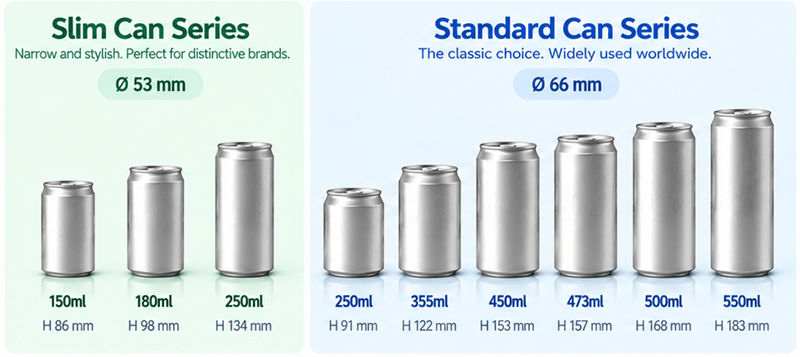
Standard Cans
The default for beer and CSD. The 66 mm body gives the best stability for stacking and pasteurization. We optimize our Standard line for 202 easy open ends, with pressure ratings up to 90 PSI (6.2 bar). Explore our Standard Aluminum Cans for 330ml, 355ml, 450ml, 473ml, 500ml and 550ml formats.
Sleek Cans
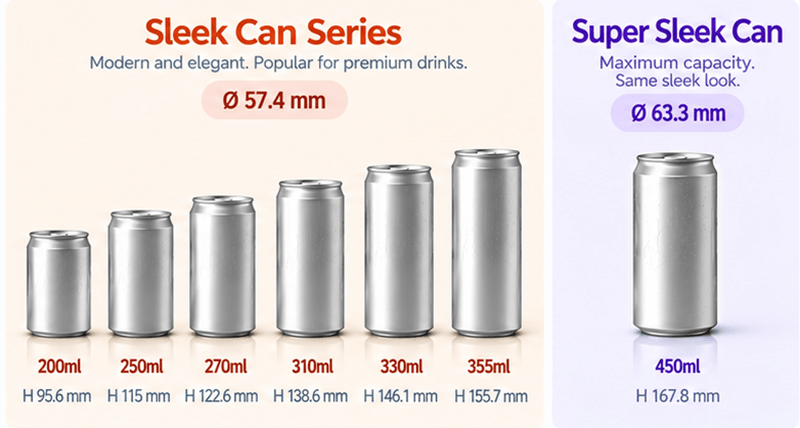
The 57.4 mm profile is common for hard seltzers, iced coffee and energy drinks. It is taller and narrower than Standard, so it fits more facings per shelf metre and signals a premium product. View Sleek Aluminum Cans in 200ml, 250ml, 270ml, 310ml, 330ml and 355ml.
Slim Cans
At 53 mm body diameter, Slim cans suit functional shots, mixers and trial sizes. The smaller diameter adds hoop stress resistance, so Slim 250ml cans can hold higher carbonation volumes. View Slim Aluminum Cans for 180ml and 250ml options.
Super Sleek Cans
The 63.3 mm Super Sleek profile bridges Standard width with Sleek styling, offering a premium 450ml format for craft beer, cocktails and ready-to-drink beverages. Explore 450ml Super Sleek Aluminum Can specifications and samples.
Standard
66mm body · 330ml/355ml/500ml
202 B64/CDL EOE
≥ 90 PSI (6.2 bar) · 389/layer
Best for: Beer & CSD
Sleek
57.4 mm body · 250ml/330ml/355ml
202/204 B64/CDL EOE
≥ 90 PSI (6.2 bar) · 517/layer
Best for: Seltzers & Energy Drinks
Slim
53mm body · 250ml
200 B64/CDL EOE
≥ 90 PSI (6.2 bar) · 598/layer
Best for: Functional Beverages & Mixers
Which Easy Open End Fits Each Aluminum Can Size?
Matching the right Easy Open End to your can profile is critical for seamer performance and shelf stability. The table below summarizes typical neck finishes and available end options by can family.
| Can Profile | Typical Neck/End | Available End Options |
|---|---|---|
| Standard | 202 | SOT Can Ends, CDL Can Ends, RPT Can Ends, B64 |
| Sleek | 202 / 200 | SOT Can Ends, CDL Can Ends, RPT Can Ends, B64 |
| Slim | 200 | SOT Can Ends, CDL Can Ends, B64 (model dependent) |
| Super Sleek | 202 | SOT Can Ends, CDL Can Ends, RPT Can Ends, Full Aperture Ends (model dependent) |
If you are unsure which end fits your filler, send us your seamer chuck spec and we will confirm whether you need a 200 or 202 neck finish.
4. Sourcing Checklist
Before you lock in a can size, confirm these three points with your supplier:
- Seamer compatibility: Confirm whether your chucks are set for 200 or 202 necks. The lid must match the can neck or you risk seam leaks.
- Axial load: Make sure the can's column strength matches your warehouse stacking height. Standard cans carry more top load than taller Slim formats.
- Internal coating: Acidic or wine-based products need a liner rated for the pH and shelf life. BPA-NI and epoxy-phenolic are the most common choices.
Need help matching a lid to your line? Send us your filler model and current lid spec. We will confirm whether you need B64, CDL or another profile and ship a sample kit for line testing.
5. Container Loading by Profile
Can dimensions affect how many units fit in a 40'HQ. The table below gives typical counts from PACKFINE loading data. Ask your supplier for a loading diagram before the first shipment so you can plan unloading labor and warehouse space.
| Can Profile | Typical 40'HQ Units (1000×1200 Pallet) | Layers per Pallet | Stacking Notes |
|---|---|---|---|
| Standard 330ml | 130,680 | 20 | Single-stack only; heavy-duty top frame required |
| Standard 355ml | 118,256 | 19 | Stable column load; ideal for long-haul ocean freight |
| Standard 450ml | 93,360 | 15 | Balanced volume and pallet stability |
| Standard 473ml (16 oz) | 93,360 | 15 | Popular North American craft beer format |
| Standard 500ml | 91,476 | 14 | European large-format; verify top frame |
| Standard 550ml | 80,912 | 13 | Tall body; check axial load for stacking |
| Sleek 200ml | 200,640 | 25 | Maximum cube efficiency; gentle handling |
| Sleek 250ml | 132,352 | 16 | High unit count per container |
| Sleek 270ml | 158,840 | 19 | Mid-size premium format |
| Sleek 310ml | 132,352 | 16 | Verify pallet pattern before shipping |
| Sleek 330ml | 133,760 | 16 | Higher cube efficiency; verify pallet pattern |
| Sleek 355ml | 124,080 | 15 | Stable for premium RTD exports |
| Super Sleek 450ml | 89,440 | ~15 | Wide-body premium format; confirm seamer chuck |
| Slim 180ml | 161,007 | 22 | Ultra-high unit count; lightweight dunnage |
| Slim 250ml | 162,656 | 17 | Maximum units per container; gentle handling required |
| Stubby 250ml | 155,600 | 25 | Short, stable format; good for craft beer |
| 1L Can | 42,240 | ~10 | Large-format; lower count, plan unloading labor |
For precision planning, use our container loading calculator to simulate counts by pallet size and can format. This reduces surprises at destination and helps co-packers schedule unloading labor efficiently.
6. Dimensional Tolerances
Small deviations in diameter, flange or neck can cause seamer jams or leaks. We check each lot against dimensional drawings with automated gauges and SPC records.
- Body diameter tolerance: ±0.10 mm
- Total height tolerance: ±0.20 mm
- Flange width: 2.35–2.55 mm for 202 neck profiles
- Countersink depth: 4.80–5.05 mm for 202 B64/CDL ends
- Axial load: ≥ 1,100 N for standard 330ml bodies
Each shipment includes a Certificate of Inspection reporting measured values, lot numbers, and coating batch traceability. Buyers can cross-check these values against their filler OEM specifications to confirm line compatibility before the container arrives.
7. Matching Can Profile to Beverage
Choose the profile based on beverage chemistry, carbonation and distribution conditions. Here is a typical match:
| Beverage Category | Recommended Profile | Rationale |
|---|---|---|
| Beer & mainstream CSD | Standard 330ml / 355ml / 473ml | Proven pasteurization performance and supply chain ubiquity |
| Hard seltzers & energy drinks | Sleek 250ml / 330ml / 355ml | Premium shelf presence with adequate pressure rating |
| Functional shots & mixers | Slim 250ml | High hoop stress tolerance and portion control |
| Craft beer & premium cider | Sleek 330ml / Standard 473ml | Brand differentiation without sacrificing filling-line compatibility |
When in doubt, start with the profile that matches your existing filler tooling and test a sample lot under real pasteurization and transport conditions before scaling to full container orders.