Many beverage brands default to glass growlers or PET bottles for sharing-size formats, not realizing that 1L aluminum cans are lighter, more recyclable, and easier to ship. But the wrong spec can inflate freight costs, limit retail placement, and create seamer-tooling problems.
This guide covers the dimensions, end compatibility, applications, and sourcing points you need to specify a 1L can correctly from the start.
A standard 1L aluminum can has a 66.0 mm body diameter and a reference height of approximately 267 mm. It is typically fitted with a 209 B64 SOT easy-open end (63.5 mm diameter) rated for 100–108 PSI, making it ideal for sharing-size beer, cider, soft drinks and functional beverages.
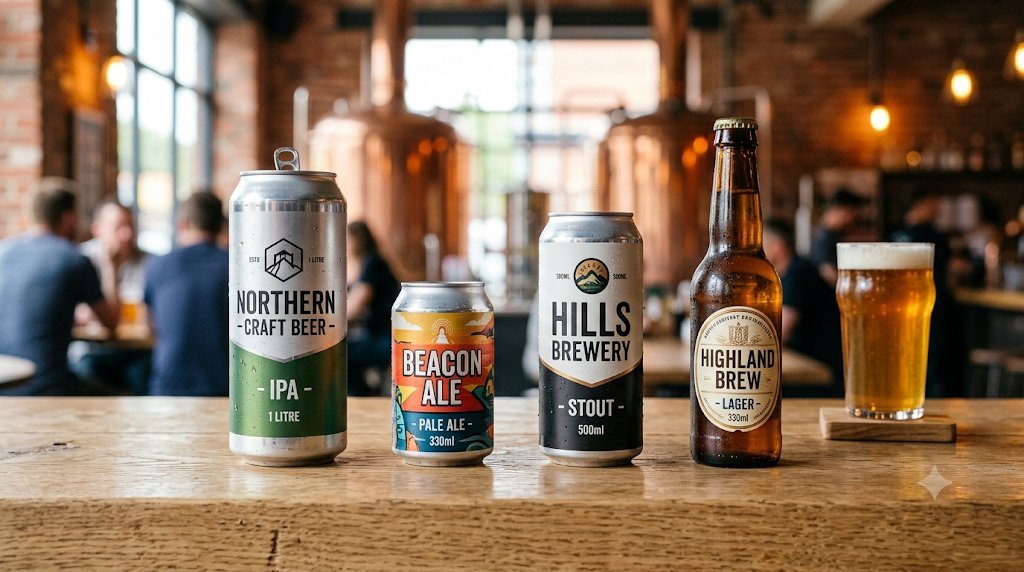
1. What Is a 1L Aluminum Can?
The 1L aluminum can—also called a 1000ml can, 1 liter can or sharing can—belongs to the Standard family of two-piece aluminum beverage cans. It uses the same 66.0 mm body diameter as the 300ml, 330ml, 355ml, 450ml, 473ml and 500ml Standard formats but is significantly taller to reach a one-liter capacity.
This format sits at the top of the Standard can range. While smaller Standard cans are designed for individual consumption, the 1L format is purpose-built for sharing occasions: parties, outdoor events, barbecues, tastings and family-size retail packs. It offers the same infinite recyclability and lightweight logistics benefits as smaller aluminum cans while competing directly with 1L glass bottles and multi-serve PET containers.
Key reasons beverage brands choose the 1L aluminum can include:
- Portability without breakage — safer than glass for outdoor and event channels
- Lightweight shipping — lower freight cost per liter than glass
- Shelf differentiation — tall, premium silhouette stands out in retail
- Infinite recyclability — aluminum retains its properties after recycling
- Single-material packaging — easier to sort and recycle than composite bottles
2. 1L Aluminum Can Dimensions and Specifications
Because the 1L can shares its body diameter with the rest of the Standard family, most filling-line conveyors, depalletizers and accumulation tables can handle it without major retrofits. The critical difference is height, which affects filler valve stroke, carton dimensions and pallet stacking patterns.
2.1 Standard 1L Can Measurements
| Dimension / Property | Metric Value | B2B Sourcing Impact |
|---|---|---|
| Nominal Capacity | 1,000 ml / 1L / 33.8 fl oz | Sharing-size format for groups and events |
| Body Diameter | 66.0 mm | Compatible with Standard-family conveyor systems |
| Reference Height | ~267 mm (±2 mm by tooling) | Requires filler height adjustment and taller carton trays |
| Neck / End Size | 209 B64 SOT (63.5 mm) | Larger opening for easier pour; requires 209 seamer chuck |
| Body Alloy | 3104-H19 | Standard aluminum beverage can alloy with excellent formability |
| End Alloy | 5182-H48 | High-strength alloy for stay-on-tab ends |
| Buckle Pressure | 100–108 PSI | Suitable for carbonated and pasteurized beverages |
| Typical Lining | BPANI or Epoxy-Phenolic | BPANI for North America/EU; Epoxy-Phenolic for cost-driven markets |
2.2 Why the 209 End Is Used on 1L Cans
Unlike smaller Standard cans that use 202 ends (52.5 mm diameter), the 1L format typically uses the larger 209 B64 SOT end with a 63.5 mm diameter. There are three practical reasons for this:
- Wider pour opening — the larger aperture improves flow rate, which matters for a sharing-size container.
- Higher pressure rating — 209 B64 SOT ends are rated for 100–108 PSI, providing a safety margin for carbonated drinks and tunnel pasteurization.
- Proportional aesthetics — the wider lid balances the tall body visually and improves consumer grip during pouring.
Brands switching from 202-end formats to 1L must confirm that their seamer is equipped with 209 tooling. Alucan provides seamer compatibility data and sample batches for on-machine testing.
2.3 Internal Coating Considerations
The taller profile of a 1L can does not change the internal coating requirements, but it does place greater emphasis on coating uniformity because the surface area is larger. Two primary lining systems are used:
- BPA-NI (BPA Non-Intent) — required for North America, the European Union and other regulated markets. These acrylic/polyester cross-linked resins are certified for food contact.
- Epoxy-Phenolic — a cost-effective option for acidic or aggressive beverages in markets where BPA-NI is not mandated.
Request food-contact migration reports and ISO 9001 / FSSC 22000 certifications regardless of the lining chosen.
3. Beverage Applications for 1L Aluminum Cans
The 1L format is not a universal replacement for single-serve cans. Its value is strongest in situations where two or more people share one container. The following categories match the format well.
3.1 Beer and Cider
Craft breweries and cider makers use 1L cans as a party pack or sharing can for sessions, tastings and outdoor events. The format replaces glass growlers and 1L swing-top bottles while eliminating breakage risk. The 209 B64 end handles typical beer carbonation (2.5–3.0 volumes CO₂) and pasteurization requirements.
3.2 Soft Drinks and Sparkling Water
For family-size retail and food-service channels, 1L aluminum cans offer a premium alternative to 1L PET bottles. The tall shape commands shelf presence, and aluminum's superior barrier properties protect carbonation longer than plastic.
3.3 Functional Beverages and RTD Cocktails
Ready-to-drink cocktails, electrolyte drinks and performance beverages positioned for group consumption can use the 1L format to differentiate from single-serve competitors. The larger canvas also supports bold, high-impact branding.
3.4 What Does Not Belong in a 1L Can?
The format is generally unsuitable for:
- Single-serve energy shots or functional shots (wrong occasion and volume)
- Premium single-serve wine (consumer expectation favors 187ml or 250ml)
- Products requiring resealability (aluminum cans are single-opening by design)
4. 1L Can vs. 500ml Can vs. Glass Bottle
Procurement teams often compare the 1L can against the 500ml can and the 1L glass bottle. The following table summarizes the practical trade-offs.
| Factor | 1L Aluminum Can | 500ml Aluminum Can | 1L Glass Bottle |
|---|---|---|---|
| Portability | Good for groups | Personal size | Heavy, breakable |
| Shipping Weight | Lightweight | Lightweight | Heavy (higher freight cost) |
| Recyclability | Infinitely recyclable | Infinitely recyclable | Recyclable but heavier to transport |
| Carbon Footprint | Lower per liter on long routes | Lower per serving | Higher due to weight |
| Branding Space | Tall, 360° canvas | Standard canvas | Limited to label area |
| Best Occasion | Sharing / parties / events | Personal consumption | Premium / dine-in |
| MOQ | Typically one container load | Typically one container load | Often lower |
Most brands do not choose between 1L and 500ml—they use both. The 500ml can drives everyday single-serve sales, while the 1L format captures sharing occasions and premium event channels.
5. Customization and Branding for 1L Cans
The tall silhouette of the 1L can provides an exceptionally large vertical canvas for brand artwork. Alucan supports the same dry-offset printing finishes on 1L cans as on other formats, including:
- Glossy — high color saturation and shelf shine
- Matte — premium, subdued tactile feel
- Frosted — subtle diffusion effect for luxury positioning
- Tactile — raised texture for enhanced grip and differentiation
For the end, brands can specify colored lids, colored pull tabs, laser-etched hollow-tab logos or under-tab QR codes. Under-tab QR codes are particularly effective for anti-counterfeit verification and customer-relationship management campaigns.
Design considerations specific to 1L cans include:
- Maintaining visual balance across the tall body
- Ensuring key branding elements remain visible when cans are stacked
- Accounting for the larger 209 end in overall composition
6. Sourcing 1L Aluminum Cans: MOQ and Lead Times
Sourcing the 1L format follows the same commercial model as other aluminum cans but with a few format-specific considerations.
6.1 Typical MOQ
The minimum order quantity for custom 1L aluminum cans is typically one container load per SKU, though exact terms depend on print complexity, coating specification and seasonal capacity. We can scale to medium and large beverage brands with scheduled production.
6.2 Lead Time Factors
- Artwork and cylinder preparation — typically 1–2 weeks after final design approval
- Coating and print trial — 1 week for sample confirmation
- Production — depends on order volume and line scheduling
- Sea freight — 2–6 weeks depending on destination
6.3 Seamer Compatibility Testing
Because the 1L can uses a 209 end, brands should request sample cans and matching ends for seamer setup and double-seam inspection before mass production. Alucan provides dimensional reports and sample batches for this purpose.
Need 1L aluminum can samples?
Ask Christine Wong for a sample batch of 1L sharing cans with dimensional reports, 209 end compatibility data, and coating specs for your seamer trials.
Request 1L samples →7. Frequently asked questions about 1L aluminum cans
What are the dimensions of a 1L aluminum can?
A standard 1L aluminum can has a body diameter of approximately 66.0 mm and a reference height of about 267 mm. It uses a 209 B64 SOT easy-open end with a diameter of 63.5 mm. Actual dimensions may vary by ±2 mm depending on tooling and manufacturer specifications.
What end size fits a 1L aluminum can?
Most 1L aluminum cans use a 209 B64 SOT (Stay-On-Tab) end with a 63.5 mm diameter. This larger end provides a wider pour opening and a higher buckle pressure rating of 100–108 PSI, making it suitable for carbonated beverages, beer and pasteurized drinks.
Which beverages are best suited for 1L cans?
1L aluminum cans are ideal for sharing-size occasions. Common applications include craft beer, cider, soft drinks, sparkling water, RTD cocktails and functional beverages. They are less suitable for single-serve energy shots or premium single-serve wine.
How many 1L cans fit in a 40HQ container?
Empty 1L can bodies ship in 40HQ containers only. Loading quantities depend on pallet pattern, tray configuration and whether cans are shipped loose or sleeved. As a rough estimate, a 40HQ container holds fewer 1L cans than 330ml or 500ml formats due to the taller profile. Contact your supplier for a precise container-loading calculation based on your specific tray and pallet requirements.
What is the MOQ for custom 1L aluminum cans?
Minimum order quantities for custom 1L aluminum cans typically start at one full container load per SKU, though exact MOQs depend on print complexity and coating requirements. We can support medium-to-large beverage brands with scheduled production lines.
Are 1L aluminum cans recyclable?
Yes. Aluminum is infinitely recyclable without loss of quality. 1L aluminum cans can be recycled through standard municipal recycling streams and generally offer a lower carbon footprint per liter of beverage than glass bottles when transport weight is considered.
Can I use a 1L can for carbonated drinks?
Yes. 1L aluminum cans are well suited for carbonated beverages when paired with a high-pressure end such as the 209 B64 SOT, which is rated for 100–108 PSI. The 3104-H19 aluminum alloy body and BPANI or epoxy-phenolic internal coating provide additional pressure resistance and product protection.
8. Conclusion
The 1L aluminum can fills a clear gap between single-serve cans and multi-liter bottles or growlers. With its 66.0 mm body diameter, ~267 mm height and 209 B64 SOT end, it is purpose-built for sharing occasions across beer, cider, soft drinks, sparkling water and RTD cocktails.
For procurement teams, the key decision factors are:
- Confirming seamer compatibility with 209 ends
- Selecting the right internal coating for the target market
- Planning carton and pallet configurations for the taller format
- Positioning the SKU for group consumption rather than single-serve
When specified correctly, the 1L can delivers lower freight costs than glass, better shelf differentiation than PET and the same infinite recyclability that makes aluminum the preferred packaging material for forward-looking beverage brands.
Ready to source 1L aluminum cans?
Contact Christine Wong to discuss dimensions, end options, MOQ, and lead times for your next sharing-size launch.
Get a 1L quote →